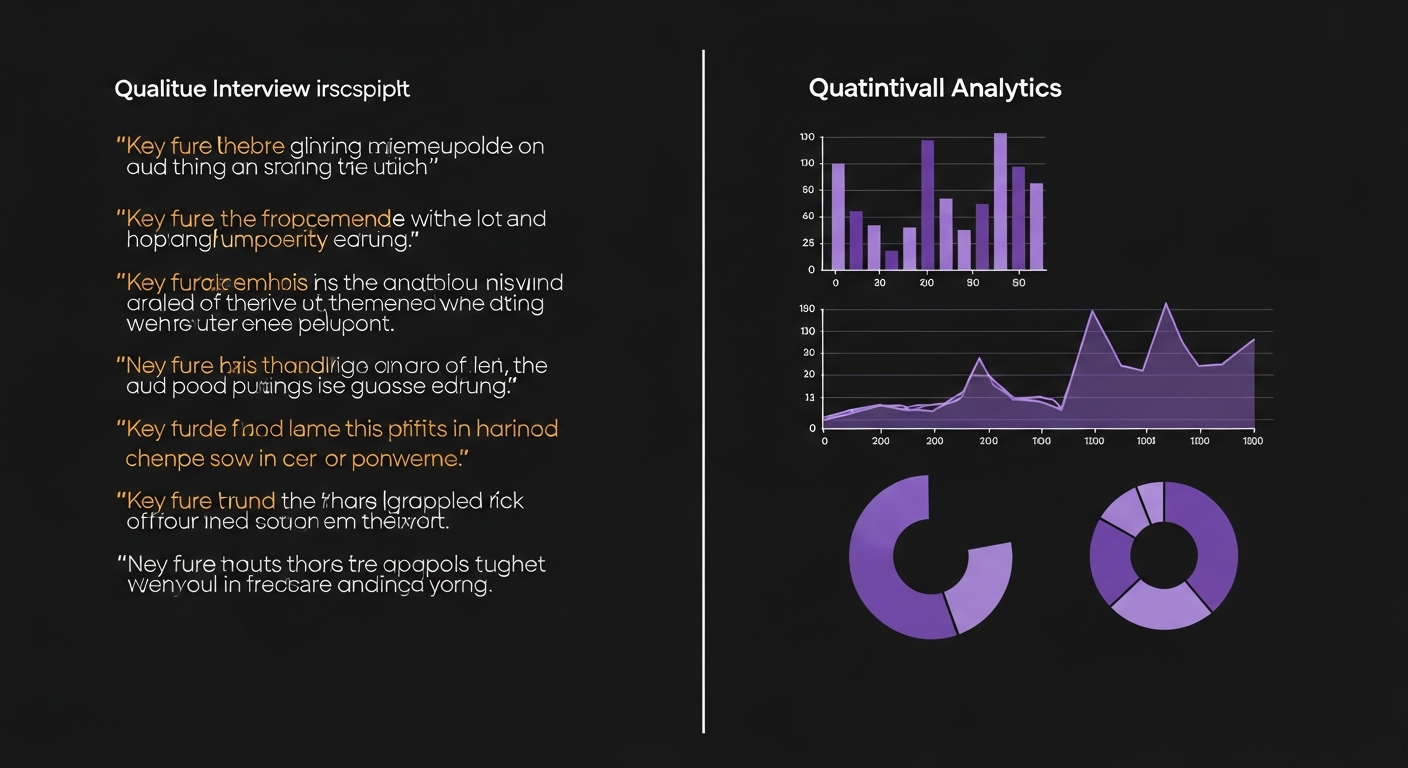
One of the most common research mistakes product managers make isn't running bad research — it's running the wrong type of research for the question they're trying to answer. Qualitative and quantitative methods answer fundamentally different questions. Using them interchangeably produces research that's expensive, time-consuming, and inconclusive.
What Qualitative Research Answers
Qualitative methods — interviews, contextual inquiry, diary studies, usability testing — answer "why" and "how" questions:
- Why do users abandon this flow?
- How do users think about this problem in their own terms?
- What does the surrounding context look like when users do this task?
- What vocabulary do customers use to describe this category?
Qualitative research is rich, contextual, and small-sample. Five to eight interviews with well-chosen participants can tell you more about "why" than a survey of 500 people. But it can't tell you "how many" or "how often."
What Quantitative Research Answers
Quantitative methods — analytics, A/B tests, surveys, NPS — answer "how many" and "how often" questions:
- What percentage of users reach step 3 of the onboarding flow?
- Does feature A increase retention compared to feature B?
- How frequently are users performing this action?
- What's the statistical distribution of use cases across our customer base?
Quantitative data is broad, statistically valid, and tells you what is happening at scale. But it rarely tells you why. A 40% drop-off at step 3 is a quantitative fact. Understanding why requires qualitative investigation.
The Sequencing Principle
The most productive research programs use qualitative and quantitative methods in sequence, not in parallel:
- Start qualitative when you're in exploration mode — you're trying to understand a problem space or form hypotheses.
- Move to quantitative when you want to validate whether your hypotheses are statistically significant or to measure the scale of a problem you've identified qualitatively.
- Return to qualitative when your quantitative data shows something unexpected — you need to understand why the numbers look the way they do.
Common Mistakes
Using surveys to understand motivation
Surveys tell you what people say they do. Interviews tell you what they actually do and why. Using a survey to understand why users churn gives you self-reported rationalizations, not accurate causes. Use interviews for motivation, surveys for prevalence.
Running interviews to validate decisions already made
Confirmation bias is powerful. If you've already decided to build something, your interview questions will subtly seek validation rather than challenge. Qualitative research is most valuable before decisions are made, not after.
Treating a small sample as representative
Six interviews tell you that this problem exists and give you rich context for understanding it. They don't tell you how widespread it is. Don't make scaling claims based on qualitative data.
The Combined Research Stack
The most effective PM research programs use a layered approach:
- Always on (quantitative): Product analytics, ongoing NPS, support ticket analysis
- Regular cadence (qualitative): Weekly customer calls, bi-weekly user interviews
- Periodic deep dives (mixed): Quarterly research sprints combining surveys and interviews for strategic decision points
This stack gives you continuous signal across both dimensions — breadth from quantitative and depth from qualitative — without requiring a dedicated research team for each layer.